
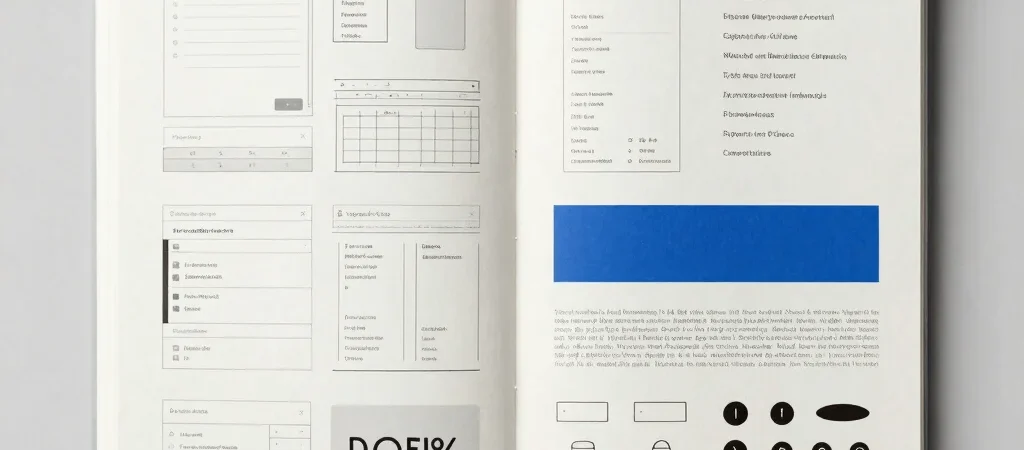
The familiar case-study sequence—challenge, moodboard, finished screens—often skips the most useful part: how one decision changed the next. Readers do not need every workshop artifact. They do need enough context to understand why the team chose a particular direction and how that choice held up in the product.
Name the actual constraint
Describe the condition shaping the work, not just the ambition. It might be an identity used across a legacy website and a new mobile service, a dense interface with a narrow type scale, or a team maintaining several product areas. Keep the context specific enough that the design problem is understandable without presenting internal details that should remain private.
Show the decision chain
Choose a few linked decisions and make their relationship visible: a brand principle informs the type hierarchy, the hierarchy changes a component, and the component behaves differently in a key screen. Show an early option beside the chosen one when the comparison clarifies a real trade-off. A sequence of considered choices teaches more than a gallery of final mockups.
Make the evidence legible
Use artifacts that support the point being made: a component comparison, a journey map excerpt, a content example, or a screen at realistic mobile scale. Explain what each artifact demonstrates instead of relying on labels like “cleaner” or “more intuitive.” If the project has no measured outcome to share, be precise about what changed in the design rather than implying results the team did not establish.
Close with what carries forward
Finish with the principle another team could apply, including where it may not fit. Perhaps the work clarified that a single display face needed a more readable partner, or that a shared color token could not serve both navigation and status feedback. That kind of takeaway connects the case study to practice—and gives the next design review a more useful starting point.